

Vehicle Control Unit Market to Reach US$ 21.8 Bn by 2033 at 8.5% CAGR | Persistence Market Research
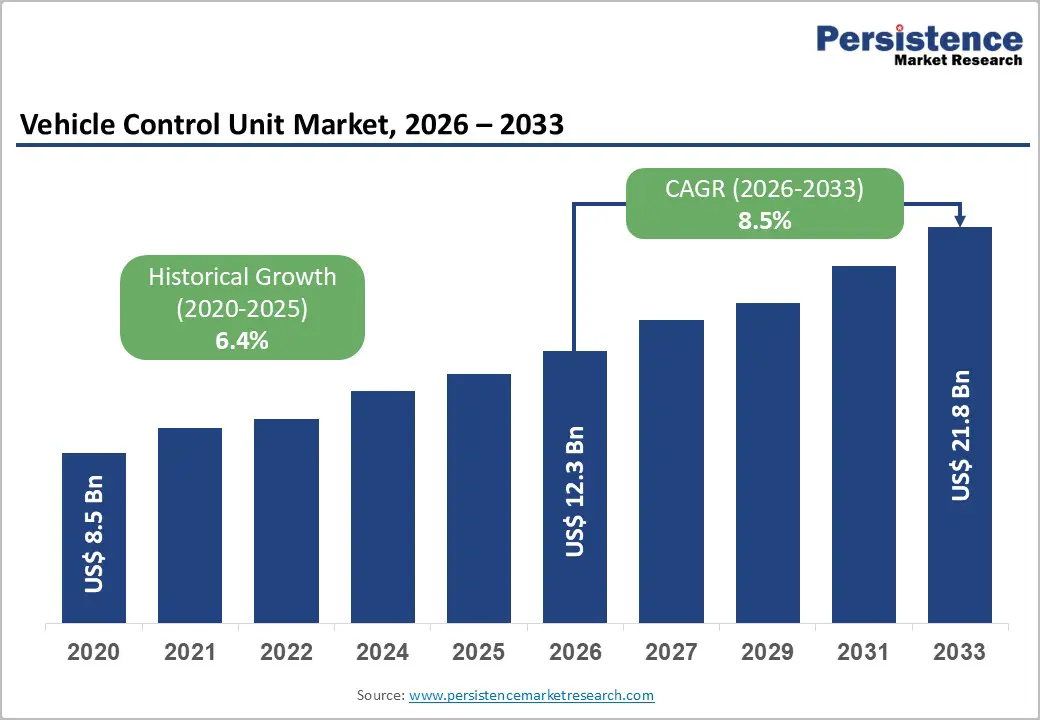
Vehicle Control Unit Market Size and Trend Analysis1
Rising electric vehicle adoption and advanced automotive electronics integration are driving strong growth in the vehicle control unit market.
BRENTFORD, LONDON, UNITED KINGDOM, April 30, 2026 /EINPresswire.com/ -- The vehicle control unit market is experiencing strong momentum as modern vehicles become increasingly dependent on electronic systems for performance, safety, and efficiency. Vehicle control units (VCUs) act as the central processing system that manages various subsystems, including powertrain, battery management, braking, and advanced driver assistance systems. With the growing shift toward electric vehicles (EVs), hybrid vehicles, and connected automotive technologies, VCUs have become critical components in ensuring seamless communication between different vehicle modules.
The global vehicle control unit (VCU) market size is valued at US$ 12.3 Bn in 2026 and is projected to reach US$ 21.8 Bn by 2033, growing at a CAGR of 8.5% between 2026 and 2033. The rapid adoption of electric vehicles, rising demand for advanced driver assistance systems, and increasing focus on vehicle electrification are key growth drivers. Among segments, electric vehicle control units are emerging as the leading category due to the surge in EV production. Asia Pacific dominates the market owing to its strong automotive manufacturing base, growing EV adoption, and government initiatives promoting clean mobility solutions.
Get Free Sample Now: https://www.persistencemarketresearch.com/samples/36692
Key Highlights from the Report
➤ The global vehicle control unit market is valued at US$ 12.3 Bn in 2026 and is expected to reach US$ 21.8 Bn by 2033, expanding at a CAGR of 8.5%.
➤ Rising adoption of electric and hybrid vehicles is significantly increasing the demand for advanced vehicle control units worldwide.
➤ Growing integration of advanced driver assistance systems is accelerating the need for efficient electronic control systems in vehicles.
➤ Technological advancements in automotive electronics are improving vehicle performance, safety, and fuel efficiency.
➤ Asia Pacific leads the market due to strong automotive production, increasing EV adoption, and supportive government policies.
➤ Increasing demand for connected and autonomous vehicles is creating new growth opportunities for VCU manufacturers globally.
Market Segmentation
By Propulsion
• Battery Electric Vehicle (BEV)
• Hybrid Electric Vehicle (HEV)
• Plug-in Hybrid Electric Vehicle (PHEV)
By Component
• Hardware
• Software
• Aluminum
• Titanium
By Voltage
• 12/24 V
• 36/48 V
By Capacity
• 16-Bit
• 32-Bit
• 64-Bit
By Region
• North America
• Europe
• East Asia
• South Asia and Oceania
• Latin America
• Middle East and Africa
Request For Customization: https://www.persistencemarketresearch.com/request-customization/36692
Regional Insights
North America
North America holds a significant share in the vehicle control unit market due to the presence of established automotive manufacturers and rapid adoption of advanced vehicle technologies. The region is witnessing increasing demand for electric vehicles and connected car solutions, which is driving the need for sophisticated VCUs. Government regulations focusing on vehicle safety and emissions are also encouraging the adoption of advanced control systems. Continuous investment in autonomous vehicle development further strengthens market growth in this region.
Europe
Europe is a key market driven by strict emission regulations and strong government support for electric mobility. The region has a well-established automotive industry with leading manufacturers focusing on innovation and sustainability. Increasing production of electric and hybrid vehicles is boosting demand for advanced vehicle control units. Additionally, the push toward smart mobility and connected vehicle technologies is contributing to the growth of the VCU market across European countries.
Asia Pacific
Asia Pacific dominates the vehicle control unit market due to its large automotive production base and rapid adoption of electric vehicles. Countries in the region are investing heavily in EV infrastructure and promoting clean energy transportation solutions. The presence of major automotive manufacturers and component suppliers further supports market expansion. Rising disposable income and increasing demand for technologically advanced vehicles are also driving the adoption of VCUs in this region.
Market Drivers
The primary driver of the vehicle control unit market is the rapid electrification of the automotive industry. Governments worldwide are implementing policies and incentives to promote electric vehicles, leading to increased production and adoption. VCUs are essential in managing complex systems within electric vehicles, including battery performance, energy distribution, and motor control. As EV adoption continues to rise, the demand for advanced control units is expected to grow significantly.
Another important driver is the increasing integration of advanced driver assistance systems and autonomous driving technologies. Modern vehicles require sophisticated electronic control systems to manage safety features such as lane departure warning, adaptive cruise control, and automated braking. VCUs enable seamless communication between these systems, enhancing vehicle safety and performance. The growing focus on vehicle connectivity and smart mobility solutions is further contributing to market growth.
Market Opportunities
The vehicle control unit market presents significant opportunities with the ongoing advancements in automotive technology. The rise of autonomous vehicles and connected car systems is creating new demand for highly sophisticated VCUs capable of managing complex operations. Manufacturers are focusing on developing advanced control units with enhanced processing capabilities and improved energy efficiency to meet evolving market requirements.
Another key opportunity lies in the expansion of electric vehicle infrastructure and production. As governments and private organizations invest in EV charging networks and sustainable transportation solutions, the demand for electric vehicles is expected to increase. This will drive the need for advanced VCUs that can efficiently manage vehicle performance and energy consumption.
The key players studied in the report include:
• ASI Robots
• Continental AG
• Delphi Technologies
• Denso Corporation
• Dorleco
• Infineon Technologies AG
• NXP Semiconductors N.V.
• Robert Bosch GmbH
• STMicroelectronics N.V.
• ZF Friedrichshafen AG
• Texas Instruments Incorporated
• Mitsubishi Electric Corporation
• Keihin Corporation
• Rimac Technology
• HiRain Technologies Co., Ltd.
• Embitel (by CARIAD Group)
• Hyundai Mobis
Buy Now: https://www.persistencemarketresearch.com/checkout/36692
Future Opportunities and Growth Prospects
The vehicle control unit market is expected to witness sustained growth driven by the rapid evolution of automotive technologies and increasing demand for electric and connected vehicles. Continuous advancements in electronics, software integration, and vehicle automation will play a crucial role in shaping the future of the market. As manufacturers focus on innovation and efficiency, the adoption of advanced VCUs is likely to expand, creating significant opportunities for growth in the coming years.
Persistence Market Research
Persistence Market Research Pvt Ltd
+1 646-878-6329
email us here
Visit us on social media:
LinkedIn
Instagram
Facebook
YouTube
X
Legal Disclaimer:
EIN Presswire provides this news content "as is" without warranty of any kind. We do not accept any responsibility or liability for the accuracy, content, images, videos, licenses, completeness, legality, or reliability of the information contained in this article. If you have any complaints or copyright issues related to this article, kindly contact the author above.
