

Global Carbon Capture and Storage (CCS) Market Led by North America; ExxonMobil, Shell, MHI Drive Decarbonization
Carbon Capture and Storage (CCS)
Carbon Capture and Storage (CCS) Market is segmented by Technology (Post-combustion, Pre-combustion, and Oxy-fuel)
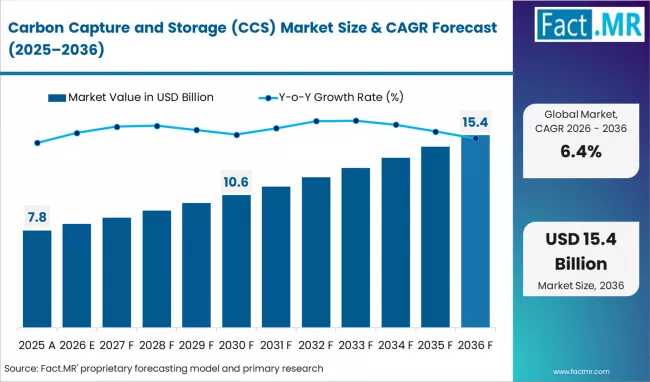
ROCKVILLE, MD, UNITED STATES, April 9, 2026 /EINPresswire.com/ -- According to Fact.MR’s latest analysis, the global carbon capture and storage (CCS) market is transitioning from pilot-scale deployments to commercial infrastructure investment. The market was valued at USD 7.80 billion in 2025, is projected to reach USD 8.30 billion in 2026, and is forecast to expand to USD 15.43 billion by 2036, registering a CAGR of 6.4%.The industry is expected to create an incremental opportunity of USD 7.13 billion during the forecast period. The transformation is being driven by carbon pricing mechanisms, regulatory decarbonization mandates, and capital expenditure requirements for hard-to-abate sectors such as power, cement, and steel.
Get detailed market forecasts, competitive benchmarking, and pricing trends:
https://www.factmr.com/connectus/sample?flag=S&rep_id=6943
Quick Stats
Market Size (2026): USD 8.30 Billion
Market Size (2027): USD 8.83 Billion (est.)
Forecast Value (2036): USD 15.43 Billion
CAGR (2026–2036): 6.4%
Incremental Opportunity: USD 7.13 Billion
Leading Technology: Post-combustion capture (50% share)
Leading End Use: Power generation (50% share)
Leading Region: North America
Key Players: ExxonMobil, Shell, Mitsubishi Heavy Industries, Chevron, TotalEnergies
Executive Insight for Decision Makers
Strategic Shift
The CCS market is shifting toward integrated carbon management infrastructure combining capture, transport, and geological storage, rather than standalone technology deployment.
What Manufacturers / Energy Companies / Investors Must Do
Secure long-term geological storage agreements early
Invest in integrated CO₂ transport infrastructure
Develop capture retrofit solutions for existing facilities
Align project economics with carbon pricing frameworks
Risks of Not Adapting
Industrial emitters delaying CCS integration face facility retirement risks, carbon penalties, and loss of regulatory compliance eligibility.
Market Dynamics
Key Growth Drivers
Carbon pricing mechanisms and emissions trading systems
Government incentives (tax credits and funding programs)
Decarbonization mandates for heavy industries
Blue hydrogen production expansion
Key Restraints
High capital expenditure requirements
CO₂ transport infrastructure constraints
Geological storage permitting timelines
Emerging Trends
Carbon capture hubs and shared infrastructure
Blue hydrogen with pre-combustion capture
Offshore CO₂ storage development
Modular capture systems for industrial retrofits
Segment Analysis
Leading Segment
Post-combustion capture dominates with 50% share, driven by retrofitting of existing facilities.
Fastest-Growing Segment
Pre-combustion capture for blue hydrogen production.
Breakdown
By Technology: Post-combustion | Pre-combustion | Oxy-fuel
By End Use: Power generation | Industrial | Others
By Application: Cement | Steel | Refining | Hydrogen | Power
Strategic Importance
Power generation provides scale, while industrial applications deliver high-margin, long-term contracts.
Supply Chain Analysis
Raw Material / Technology Providers
Solvent and absorbent manufacturers
Membrane technology suppliers
Compression equipment manufacturers
Pipeline material suppliers
Manufacturers / System Integrators
CCS technology developers
EPC contractors
Engineering solution providers
Distributors / Infrastructure Operators
Pipeline operators
CO₂ transport companies
Storage site developers
End Users
Power plants
Cement manufacturers
Steel producers
Oil & gas refineries
Hydrogen producers
Who Supplies Whom
Technology suppliers provide capture systems to EPC contractors. EPC companies integrate capture units and build CO₂ pipelines. Infrastructure operators transport CO₂ to storage providers. Industrial emitters purchase turnkey CCS solutions to meet decarbonization targets.
Pricing Trends
Project-based pricing rather than commodity pricing
Premium pricing for integrated capture + storage solutions
Pricing influenced by:
Carbon credit value
Capture efficiency
Storage distance
Regulatory incentives
Margin Insight
Highest margins observed in integrated CCS infrastructure and long-term service agreements.
Regional Analysis
Top Countries by CAGR
United States – 7.0%
Mexico – 6.4%
Germany – 6.0%
France – 5.8%
United Kingdom – 5.5%
Regional Growth Drivers
USA: 45Q tax credits and Gulf Coast storage hubs
Mexico: Industrial decarbonization initiatives
Germany: EU ETS compliance requirements
France: Industrial emissions reduction programs
UK: Carbon capture cluster development
Developed vs Emerging Markets
Developed markets lead infrastructure investment
Emerging markets focus on pilot and demonstration projects
Competitive Landscape
The CCS market is moderately consolidated, dominated by energy majors and EPC contractors.
Key Players
ExxonMobil
Shell
Chevron
TotalEnergies
Mitsubishi Heavy Industries
Aker Solutions
Fluor Corporation
Linde
Saipem
TechnipFMC
Competitive Strategies
Integrated CCS infrastructure development
Strategic partnerships with industrial emitters
Technology licensing models
Storage hub development
Strategic Takeaways
For Manufacturers / Technology Providers
Develop modular capture solutions
Offer turnkey infrastructure packages
For Investors
Focus on storage infrastructure and pipelines
Target tax incentive-supported projects
For Marketers / EPC Contractors
Build integrated capture-to-storage offerings
Develop regional CCS hubs
Future Outlook
The CCS market will evolve into regional carbon management infrastructure networks. Long-term growth will be driven by industrial decarbonization mandates and carbon trading economics.
Key opportunity areas:
Blue hydrogen projects
Industrial retrofits
Offshore storage
Cross-border CO₂ pipelines
Conclusion
The global carbon capture and storage market is transitioning from experimental technology to core decarbonization infrastructure. Companies investing in integrated capture, transport, and storage capabilities will capture long-term opportunities as the market approaches USD 15.43 billion by 2036.
Why This Market Matters
Enables large-scale industrial decarbonization
Supports net-zero commitments
Reduces carbon compliance costs
Creates new energy infrastructure investment opportunities
Full Report: Unlock 360° insights for strategic decision making and investment planning-
https://www.factmr.com/checkout/6943
To View Related Report:
Carbon Credit Eligible Fertility Program Market https://www.factmr.com/report/carbon-credit-eligible-fertility-program-market
Carbon Prepreg Market https://www.factmr.com/report/carbon-prepreg-market
Carbon-Negative Fabrics Market https://www.factmr.com/report/carbon-negative-fabrics-market
Carbon Fiber-Reinforced Carbon Market https://www.factmr.com/report/carbon-fiber-reinforced-carbon-market
S. N. Jha
Fact.MR
+1 628-251-1583
email us here
Legal Disclaimer:
EIN Presswire provides this news content "as is" without warranty of any kind. We do not accept any responsibility or liability for the accuracy, content, images, videos, licenses, completeness, legality, or reliability of the information contained in this article. If you have any complaints or copyright issues related to this article, kindly contact the author above.
