

Bio-Based Acetic Acid Market Forecast: Europe Leads Green Chemicals as Celanese Corporation, LyondellBasell
Bio-Based Acetic Acid Market
Transitioning to Green Chemistry: The Strategic Rise of the Global Bio-Based Acetic Acid Market
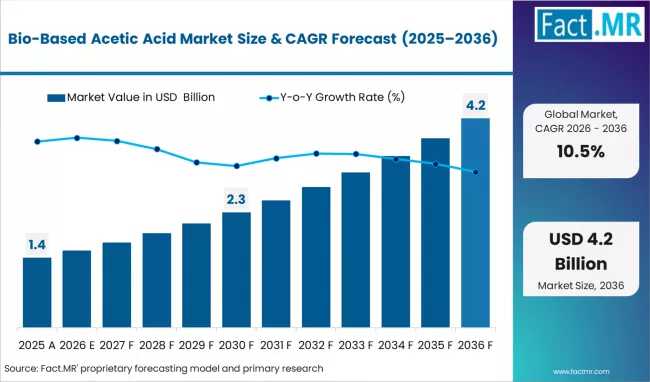
ROCKVILLE, MD, UNITED STATES, April 1, 2026 /EINPresswire.com/ -- The global chemical landscape is witnessing a seismic shift. As corporate mandates for Scope 3 emissions reduction intensify, the move from petrochemical-derived intermediates to sustainable alternatives is no longer a ""green luxury""—it is a procurement necessity. At the heart of this transition is the Bio-Based Acetic Acid Market, a sector rapidly evolving from a niche premium category into a mainstream industrial staple.Valued at USD 1.40 billion in 2025, the market is on a high-growth trajectory, projected to hit USD 1.55 billion in 2026 and soar to USD 4.20 billion by 2036. This represents a robust 10.50% CAGR, creating a massive USD 2.65 billion incremental opportunity for early movers and strategic investors.
For Details Deep insights, Please Request A sample report for Free https://www.factmr.com/connectus/sample?flag=S&rep_id=1189
The Decision-Maker’s Perspective: Why the Shift is Accelerating
For C-suite executives and procurement directors in the food, beverage, and pharmaceutical sectors, the value proposition of bio-based acetic acid transcends simple environmental stewardship. It is about future-proofing the supply chain.
Regulatory Resilience: With the EU Bio-economy strategy and global decarbonization programs in full swing, bio-based content certification is becoming a ""license to operate.""
Drop-in Compatibility: Modern bio-based acetic acid acts as a direct replacement for its synthetic counterpart, requiring zero changes to existing production lines in vinegar manufacturing or pH adjustment processes.
Cost Convergence: Advanced biomass and gas fermentation technologies are progressively closing the price gap with fossil-fuel alternatives, making the ""green premium"" increasingly manageable.
Market Intelligence: Quick Stats & Forecasts
Metric Details
Market Value (2025) USD 1.40 Billion
Projected Value (2036) USD 4.20 Billion
Growth Rate (CAGR) 10.50% (2026–2036)
Dominant Segment Food & Beverage (64% Application Share)
Leading Technology Biomass Fermentation (42% Source Share)
Top Growth Market USA (11.2% CAGR)
Regional Growth Engines: A Global Comparison
The drive toward sustainability is a global phenomenon, but specific regions are emerging as high-velocity hubs due to infrastructure and policy support:
USA (11.2% CAGR): Leading the charge through a sophisticated biotechnology corridor and aggressive pharmaceutical sustainability targets.
Mexico (10.7% CAGR): Leveraging vast agricultural residues to become a critical North American hub for renewable feedstocks.
Germany (10.3% CAGR): The anchor of European demand, driven by the chemical industry’s mission to achieve carbon neutrality.
France (10.1% CAGR): Focusing on biorefinery innovation and circular economy leadership.
Expert Analysis: The Purity Pivot
""We are at the tipping point where production volume consistency at food-grade purity (99.5%+) is the only variable that matters. Producers who can document batch-to-batch consistency will lock in multi-year supply contracts as food manufacturer procurement cycles reset over the next 24 months.""
— Shambhu Nath Jha, Principal Consultant for Chemicals and Materials at Fact.MR
Competitive Landscape: The Innovation Leaders
The market is being defined by players who can scale production while maintaining rigorous sustainability certifications.
LanzaTech Inc. (13.0% market share) leads with a focus on waste-to-chemical technologies.
Wacker Chemie AG and Godavari Biorefineries Ltd. are setting benchmarks in quality excellence and agricultural waste utilization.
Afyren S.A. and Novozymes A/S continue to push the boundaries of fermentation efficiency and enzyme technology.
Strategic Recommendations for Stakeholders
For Producers: Prioritize achieving 99.5% food-grade purity and invest in third-party lifecycle carbon intensity documentation to satisfy retail audit requirements.
For Procurement Teams: Diversify biomass supply agreements across multiple residue sources to mitigate the risks of seasonal pricing variability.
For Investors: Look toward the Industrial End-Use segment, which currently commands a 64.0% market share, as the primary engine for long-term volume stability.
For instant access to this report, click ""Buy Now"" or connect with our analyst for customization: https://www.factmr.com/checkout/1189
Access More Insights: Related Market Reports
To gain a comprehensive edge in the sustainable chemicals landscape, explore these related intelligence briefings from Fact.MR:
Gamma-hydroxybutyric Acid Market https://www.factmr.com/report/4991/gamma-hydroxybutyric-acid-market
Ellagic acid Market https://www.factmr.com/report/5055/ellagic-acid-market
Perchloric Acid Market https://www.factmr.com/report/5159/perchloric-acid-market
Oleic Acid Market https://www.factmr.com/report/5233/oleic-acid-market
S. N. Jha
Fact.MR
+ +1 628-251-1583
email us here
Legal Disclaimer:
EIN Presswire provides this news content "as is" without warranty of any kind. We do not accept any responsibility or liability for the accuracy, content, images, videos, licenses, completeness, legality, or reliability of the information contained in this article. If you have any complaints or copyright issues related to this article, kindly contact the author above.
