

Regenerative Brake Calibration Services Market to Grow at 11.6% CAGR on Rising EV Software Complexity
Regenerative Brake Calibration Services Market
Growing EV platform variants and software-defined braking push calibration services demand toward USD 802.5 million by 2036.
NEWARK, DE, UNITED STATES, January 22, 2026 /EINPresswire.com/ -- Market Overview: Calibration Becomes Central to EV Development
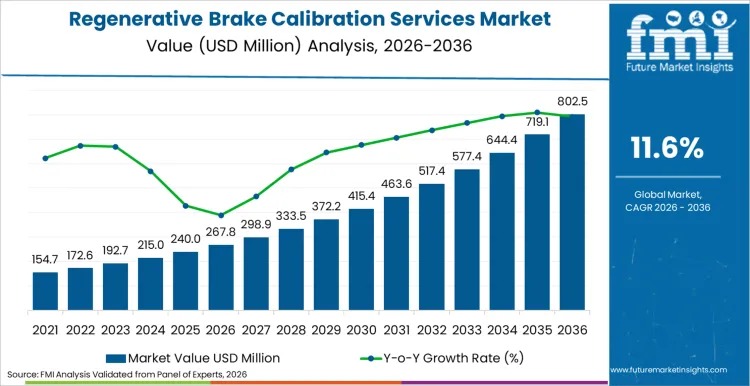
The Regenerative Brake Calibration Services Market is transitioning from a support function to a mission-critical engineering service within electric vehicle (EV) development. Valued at USD 267.8 million in 2026, the market is forecast to reach USD 802.5 million by 2036, expanding at a strong 11.6% CAGR. This growth is driven by the rapid increase in software-controlled braking systems and the rising number of EV platforms and derivatives launched globally.
Unlike conventional braking, regenerative systems require continuous tuning of pedal maps, brake blending logic, and energy recovery limits. Each new battery option, powertrain variant, or regional homologation requirement multiplies the calibration workload. As EV portfolios expand, calibration services scale directly with platform complexity rather than vehicle volume alone.
Request For Sample Report | Customize Report | Purchase Full Report –
https://www.futuremarketinsights.com/reports/sample/rep-gb-31700
Key Growth Drivers Shaping the Market
The market’s momentum is anchored in structural changes across vehicle engineering and validation:
- Platform Proliferation: Each EV family spawns multiple derivatives, expanding calibration scope across trims and regions.
- Software-Defined Braking: Brake behavior is now governed by code, increasing validation cycles with every software release.
- Safety and Compliance Pressure: Regenerative braking is embedded in safety cases, requiring traceable datasets and audit-ready documentation.
- Shorter Product Cycles: Parallel vehicle development programs drive sustained demand for external calibration capacity.
Once a vehicle program enters development, calibration engagements typically span the full lifecycle. OEMs often outsource peak workloads and variant expansion while retaining strategic control over baseline tuning.
Market Size and Forecast Outlook (2026–2036)
The regenerative brake calibration services market reflects rising validation intensity per vehicle:
- 2026 Market Value: USD 267.8 million
- 2030 Market Value: ~USD 415.4 million
- 2036 Market Value: USD 802.5 million
- Forecast CAGR (2026–2036): 11.6%
Growth is fueled by higher test mileage, increased use of hardware-in-the-loop (HIL) and software-in-the-loop (SiL) validation, and longer stabilization phases tied to centralized vehicle control architectures.
Why Vehicle-Level Calibration Dominates Demand
Vehicle-level calibration represents the largest service share, accounting for roughly 42% of total demand. Its dominance is explained by its role as the final authority on:
- Pedal feel consistency and driver perception
- Regenerative-to-friction brake blending behavior
- Deceleration predictability under diverse operating conditions
- Stability and fault-containment performance for homologation
Once OEMs select a calibration framework, they standardize acceptance thresholds and release gates around it. Any methodological change would require revalidation, reinforcing long-term service continuity.
OEMs Lead as Primary Customers
Original Equipment Manufacturers account for approximately 54% of market demand. Their leadership stems from:
- Responsibility for final vehicle behavior and brand-specific brake feel
- Direct ownership of homologation and compliance sign-off
- High exposure to validation failure and launch delays
Tier-1 suppliers participate mainly where subsystems are delivered as integrated stacks, while startups and autonomy developers rely on external services to offset limited internal validation infrastructure.
Regional Growth Trends Highlight EV Hotspots
Demand growth closely mirrors EV adoption and manufacturing strategies:
- China (13.8% CAGR): High-volume EV production and rapid platform scaling
- Brazil (13.6% CAGR): Expanding hybrid and EV programs
- United States (11.1% CAGR): Fleet electrification and regulatory compliance
- United Kingdom (10.7% CAGR): Multi-model integration and safety standards
- Japan (10.0% CAGR): Mature EV market focused on reliability and drivability
Integration Complexity Raises the Value of Calibration Services
Regenerative braking now depends on tight coordination between inverter logic, battery management systems, hydraulic fallback layers, and vehicle dynamics control software. These interdependencies prevent simple reuse of calibration assets and keep services program-specific. OEMs increasingly involve calibration providers earlier in system architecture definition to reduce late-stage integration risk.
Competitive Landscape and Strategic Positioning
Leading players including AVL List, Bosch Engineering, FEV Group, Ricardo, KPIT Technologies, Tata Technologies, dSPACE, Capgemini Engineering, ALTEN Group, and EDAG Engineering compete on:
- Repeatability of calibration outcomes
- Toolchain compatibility and audit acceptance
- Ability to scale across multiple vehicle programs
Long-term advantage depends on data reuse frameworks, virtual validation capabilities, and deep integration with OEM software environments.
Related Reports
Software Defined Vehicle Market- https://www.futuremarketinsights.com/reports/software-defined-vehicle-market
Aircraft Weapons Market- https://www.futuremarketinsights.com/reports/aircraft-weapons-market
Rail System Dryer Market- https://www.futuremarketinsights.com/reports/rail-system-dryer-market
Have a specific Requirements and Need Assistant on Report Pricing or Limited Budget please contact us - sales@futuremarketinsights.com
About Future Market Insights (FMI)
Future Market Insights, Inc. (FMI) is an ESOMAR-certified, ISO 9001:2015 market research and consulting organization, trusted by Fortune 500 clients and global enterprises. With operations in the U.S., UK, India, and Dubai, FMI provides data-backed insights and strategic intelligence across 30+ industries and 1200 markets worldwide.
Contact Us:
Future Market Insights Inc.
Christiana Corporate, 200 Continental Drive,
Suite 401, Newark, Delaware - 19713, USA
T: +1-347-918-3531
Why FMI: https://www.futuremarketinsights.com/why-fmi
For Sales Enquiries: sales@futuremarketinsights.com
Website: https://www.futuremarketinsights.com
LinkedIn| Twitter| Blogs | YouTube
Sudip Saha
Future Market Insights Inc.
+1 347-918-3531
email us here
Legal Disclaimer:
EIN Presswire provides this news content "as is" without warranty of any kind. We do not accept any responsibility or liability for the accuracy, content, images, videos, licenses, completeness, legality, or reliability of the information contained in this article. If you have any complaints or copyright issues related to this article, kindly contact the author above.
