

Next-Generation Autonomous Yard Vehicles Market Trends 2026-2036: Innovation Catalysts, Regulatory Impact
Autonomous Yard Vehicles Market
Global Autonomous Yard Vehicles Market Projected to Reach USD 5.7 Billion by 2036 as Logistics Automation Accelerates
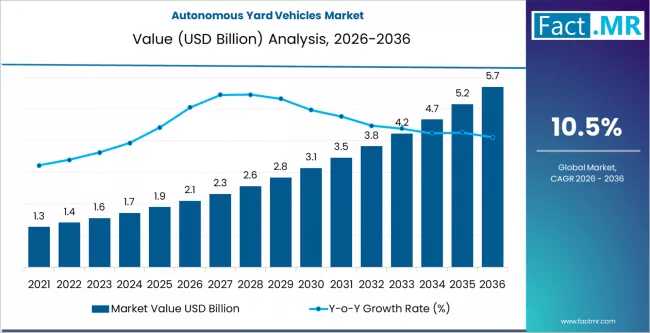
UNITED STATES, MD, UNITED STATES, January 19, 2026 /EINPresswire.com/ -- The global autonomous yard vehicles market is entering a phase of exponential expansion, projected to grow from USD 2.1 billion in 2026 to USD 5.7 billion by 2036. According to recent industry analysis, this transition represents a compound annual growth rate (CAGR) of 10.5%, driven by a structural shift in how distribution centers, ports, and manufacturing facilities manage material handling and fleet optimization.As global supply chains face persistent labor shortages and rising operational costs, autonomous yard trucks, terminal tractors, and automated guided vehicles (AGVs) have matured from experimental pilots to essential infrastructure. The surge in adoption is particularly visible in geofenced environments where high-frequency, repetitive trailer movements allow for seamless automation without the regulatory complexities of public highways.
Request for Sample Report | Customize Report |purchase Full Report - https://www.factmr.com/connectus/sample?flag=S&rep_id=13693
Core Market Drivers: Efficiency, Safety, and Sustainability
The transition toward autonomous yard operations is fueled by three critical industry imperatives:
Operational Continuity: Unlike manual operations limited by driver hours-of-service, autonomous vehicles enable 24/7 throughput. This continuous operational capability is vital for e-commerce hubs and ports seeking to mitigate congestion and improve truck turn time (TTT).
Safety and Risk Mitigation: Human error contributes to nearly 90% of industrial yard accidents. By utilizing sensor fusion—integrating LiDAR, radar, and high-definition cameras—autonomous yard vehicles achieve collision avoidance accuracy levels that significantly exceed human performance.
Environmental Responsibility: A substantial portion of the new autonomous fleet is built on electric powertrains. This shift supports corporate ESG goals by reducing carbon footprints and eliminating idling emissions during trailer spotting and container shuffling.
Dominant Segments and Regional Growth
Data-backed insights reveal that container handling remains the leading application category, currently commanding a 58.3% market share. Meanwhile, distribution centers represent the largest end-use segment at 47.2%, highlighting the critical role of automation in managing the explosive growth of global e-commerce.
While North America and Europe remain early adopters due to high labor costs, the Asia-Pacific region is emerging as the fastest-growing market. India is projected to lead with a CAGR of 13.2%, closely followed by China at 12.6%, supported by massive investments in smart port infrastructure and large-scale manufacturing automation.
The Role of Artificial Intelligence and Connectivity
The maturation of AI and machine learning is the primary catalyst for this market's acceleration. Modern autonomous systems now utilize large language models and transformer-based deep learning to recognize complex edge cases in real-time. Furthermore, the integration of 5G and V2X (Vehicle-to-Everything) communication allows these vehicles to synchronize with Yard Management Systems (YMS), ensuring First-In, First-Out (FIFO) inventory precision and optimized route planning.
Future Outlook
Industry analysts expect enterprise spending to follow disciplined, outcome-oriented patterns over the next 24 months. As technology providers transition to Autonomous-as-a-Service models, the barrier to entry for mid-sized logistics providers is lowering, paving the way for widespread adoption across global supply chains.
The integration of autonomous yard vehicles is no longer a question of if, but how fast. By removing the bottlenecks of manual yard movement, enterprises are realizing a more resilient, scalable, and safer future for global trade.
About the Industry Analysis: This market update is based on the latest 2026 industrial goods forecast and outlook, providing a comprehensive view of the autonomous yard vehicle landscape, including historical data from 2021-2025 and projections through 2036.
Browse Full Report : https://www.factmr.com/report/autonomous-yard-vehicles-market
To View Related Report :
Hybrid Electric Vehicles Market
https://www.factmr.com/report/270/hybrid-electric-vehicles-market
Hydrogen Vehicles Market
https://www.factmr.com/report/685/hydrogen-vehicle-market
Emergency Medical Services (EMS) Vehicles Market
https://www.factmr.com/report/837/emergency-medical-services-vehicles-market
Heavy Vehicles Suspension Anti-vibration Components Market
https://www.factmr.com/report/1248/heavy-vehicles-suspension-anti-vibration-components-market
About Fact.MR
Fact.MR is a global market research and consulting firm, trusted by Fortune 500 companies and emerging businesses for reliable insights and strategic intelligence. With a presence across the U.S., UK, India, and Dubai, we deliver data-driven research and tailored consulting solutions across 30+ industries and 1,000+ markets. Backed by deep expertise and advanced analytics, Fact.MR helps organizations uncover opportunities, reduce risks, and make informed decisions for sustainable growth.
S. N. Jha
Fact.MR
+1 628-251-1583
email us here
Legal Disclaimer:
EIN Presswire provides this news content "as is" without warranty of any kind. We do not accept any responsibility or liability for the accuracy, content, images, videos, licenses, completeness, legality, or reliability of the information contained in this article. If you have any complaints or copyright issues related to this article, kindly contact the author above.
